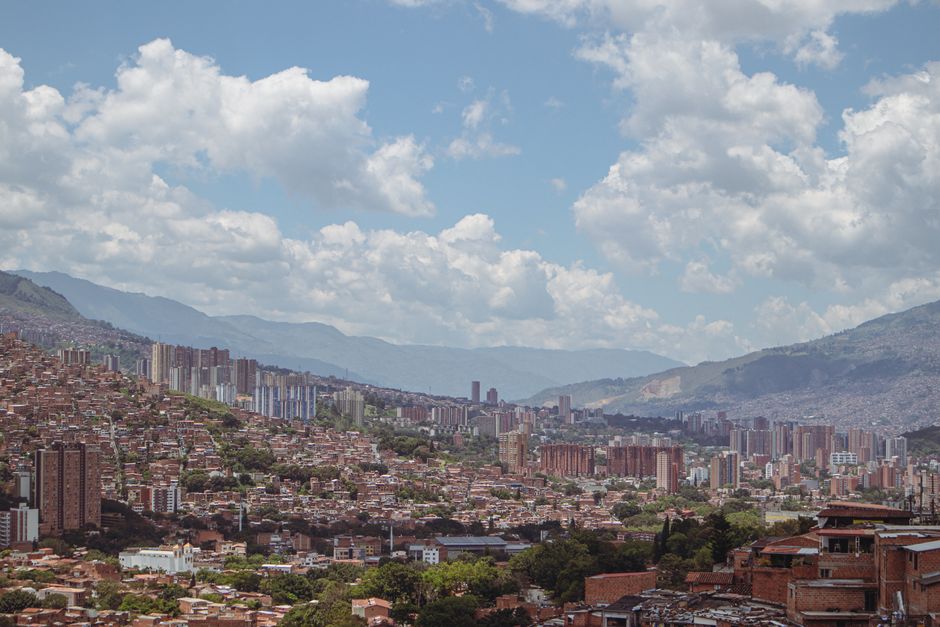
Carolina Restrepo launched Verdpack out of a 40-square-metre workshop off Calle 33 in Laureles three years ago with 18 million pesos in seed funding and a single industrial press. By June 2026, the company had signed its first European distribution contract, a 200,000-unit annual order from a German grocery chain, and moved into a 600-square-metre production floor in the Parque Industrial de Itagüí, just south of the city limits.
The product is deceptively simple: rigid packaging trays made from compacted sugarcane bagasse and banana leaf fibres, both sourced from farms in Urabá and the Eje Cafetero. They decompose in 90 days in open compost. Conventional plastic trays can persist for 450 years.
Why Medellín, Why Now
The timing is not coincidental. Europe's extended heatwave this summer, France alone recorded more than 2,000 excess deaths at the peak, has accelerated political pressure on retailers to cut single-use plastics from their supply chains ahead of the EU Packaging and Packaging Waste Regulation deadline of January 2030. That regulatory cliff is generating real commercial urgency, and Colombian suppliers who can certify compostable materials at competitive prices are suddenly fielding calls they were not getting eighteen months ago.
Verdpack is one of roughly 60 active companies in Ruta N's bioeconomy vertical, the innovation district anchored at Carrera 52 with Calle 67 in Sevilla that the city government has spent a decade building into a credible tech hub. Ruta N's 2025 impact report put total private investment channelled through its programmes at 1.4 trillion pesos, about 340 million US dollars, since 2012. The bioeconomy cohort, which Restrepo joined in 2024 through the Núcleo de Innovación Ambiental accelerator, accounts for roughly 9 percent of that portfolio.
Restrepo declined an interview request this week, citing a due-diligence process with a prospective investor. But her company's trajectory is legible in public filings and in the observations of people who work alongside it. ProColombia, the national export promotion body, listed Verdpack as one of 14 Antioquia-based startups in its 2026 Green Export Pipeline, a curated slate of companies being prepared for trade shows in Frankfurt and Seoul later this year.
The Numbers Behind the Story
The economics are tighter than they look from the outside. Bagasse, a byproduct of the panela and sugar industries, costs Verdpack roughly 180 pesos per kilogram at source. Conventional expanded polystyrene trays run Colombian food processors about 95 pesos per unit at wholesale. Verdpack's trays currently price at 210 pesos per unit for domestic buyers, a premium that most mid-tier supermarkets have been reluctant to absorb. The German contract works financially precisely because European buyers pay in euros and face regulatory cost if they do not switch materials.
That currency advantage is significant. The peso has weakened roughly 12 percent against the euro since January 2025, meaning Verdpack's production costs in pesos translate into increasingly competitive euro prices. For the Itagüí facility, which employs 23 full-time workers, 17 of them women from the Municipio de Itagüí's social employment programme, the export margin is running at around 34 percent, according to a pitch deck filed with Bancoldex, Colombia's development bank, in April 2026.
Verdpack is also in preliminary talks with Grupo Nutresa, the Medellín-based food conglomerate, about a domestic supply arrangement for its prepared-foods division. A deal there would change the domestic cost equation entirely by providing the scale needed to bring local prices closer to polystyrene parity.
For other founders watching this play out, the lesson is fairly direct: the path Restrepo has taken, Ruta N incubation, ProColombia pipeline, patient work on cost structure, is replicable. The city's innovation infrastructure exists specifically to de-risk this kind of bet. Entrepreneurs in Medellín's growing materials-science and agro-industrial sectors would do well to map their products against the EU's 2030 packaging rules now, while the window for early-mover supplier relationships is still open. The German grocery chain that signed with Verdpack was looking for a second supplier as recently as last October. It is not looking anymore.
This article was compiled by AI and screened before publishing. See our editorial standards.