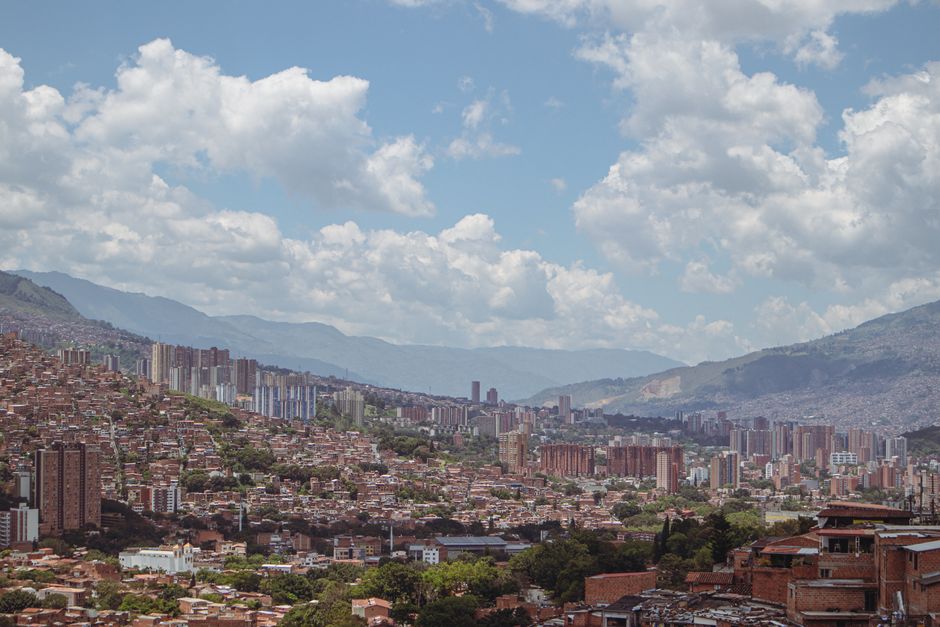
Medellín's economy entered the second half of 2026 under significant strain. Office vacancy rates in the Milla de Oro corridor on Avenida El Poblado have climbed to roughly 18 percent, according to figures from the Lonja de Propiedad Raíz de Antioquia, the highest level since 2019, while small business formations registered at the Cámara de Comercio de Medellín para Antioquia fell nearly 11 percent in the first five months of the year compared with the same period in 2025.
The timing matters. A string of global disruptions, energy supply anxiety linked to ongoing conflict in Europe, currency volatility tied to political transitions in the Middle East following the death of Iran's Supreme Leader, and continued uncertainty over Chinese trade policy, has cooled foreign direct investment flows into Colombian cities. Medellín, which has spent a decade marketing itself as a tech and innovation hub, is feeling that chill more sharply than officials had anticipated when they drafted the city's 2026 economic plan last October.
Peso Pressure and Property Pain
The Colombian peso has weakened against the dollar through most of 2026, hovering around 4,350 COP per USD in late June. That sounds like good news for exporters, but for Medellín's large class of importers, electronics retailers on Avenida Oriental, fabric wholesalers in the Distrito de Moda near the old Bronx precinct, it means higher input costs with little room to pass them on to consumers already watching their wallets. The Banco de la República held its benchmark interest rate at 9.25 percent as of its June meeting, keeping mortgage financing expensive and dampening the residential property market that had been one of the city's reliable growth engines.
New apartment sales in Sabaneta and Envigado, the southern municipalities that absorbed much of the metro area's middle-class residential boom between 2021 and 2024, dropped about 22 percent in unit terms during the first quarter of 2026, according to data compiled by Coordenada Urbana, the construction industry's national research arm. Average asking prices per square metre in Laureles still sit above 7.5 million COP, but developers are offering financing incentives not seen since the pandemic years. Several mid-scale projects in the Barrio Conquistadores area have quietly delayed groundbreaking dates from mid-2026 to early 2027.
The Jobs Picture and What Entrepreneurs Are Doing About It
Unemployment in the Área Metropolitana del Valle de Aburrá ticked up to 10.8 percent in April 2026, the most recent month for which the national statistics agency DANE has published figures, erasing gains made through late 2024 and early 2025. The services and retail sectors account for the bulk of the new joblessness. Ruta N, the city's innovation and technology corporation anchored on Calle 67 in the northern part of the urban core, has expanded its Emprende+ acceleration programme to take on an additional 120 startups this cycle, partly as a cushion against layoffs bleeding talent from the formal sector.
Some operators are doubling down on tourism-adjacent revenue. The cluster of boutique hotels and co-working spaces around Parque Lleras in El Poblado report that occupancy from digital nomads, many of them European and North American remote workers, has remained relatively firm even as corporate travel budgets tighten. But that segment alone cannot carry a metro economy of 4.3 million people.
For businesses trying to survive the next six months, the practical priorities are clear: lock in peso-denominated supply contracts before any further currency moves, engage with Bancóldex financing lines that carry subsidised rates for exporters, and monitor whether the Ministerio de Comercio, Industria y Turismo moves forward with the simplified SME tax regime it floated in May. The city's annual Feria de Negocios, scheduled for September at Plaza Mayor on Calle 41, will offer one of the first real public readings of whether confidence is stabilising or eroding further. Nobody in the business community is expecting a straight-line recovery before year-end.